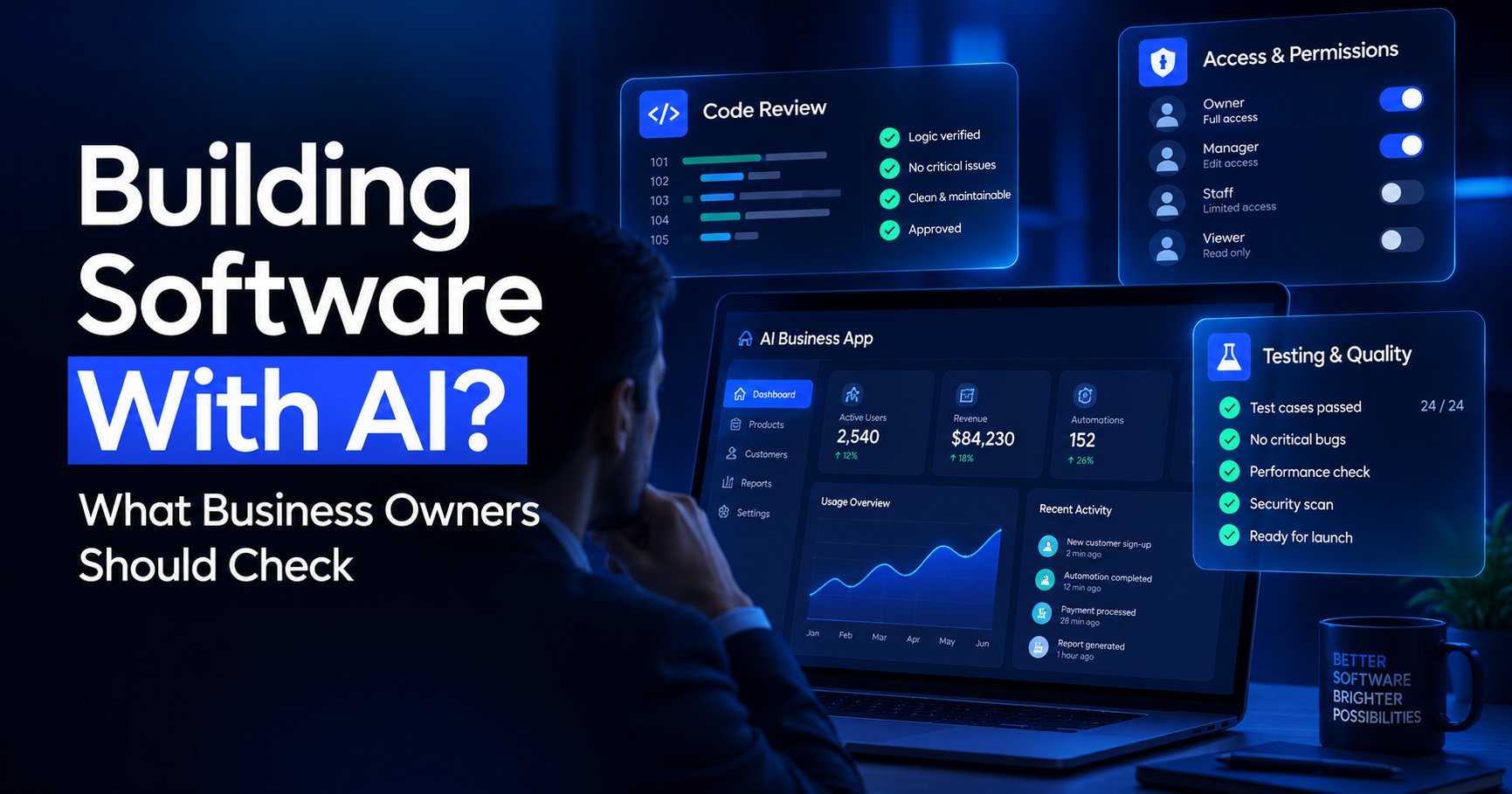
The short answer
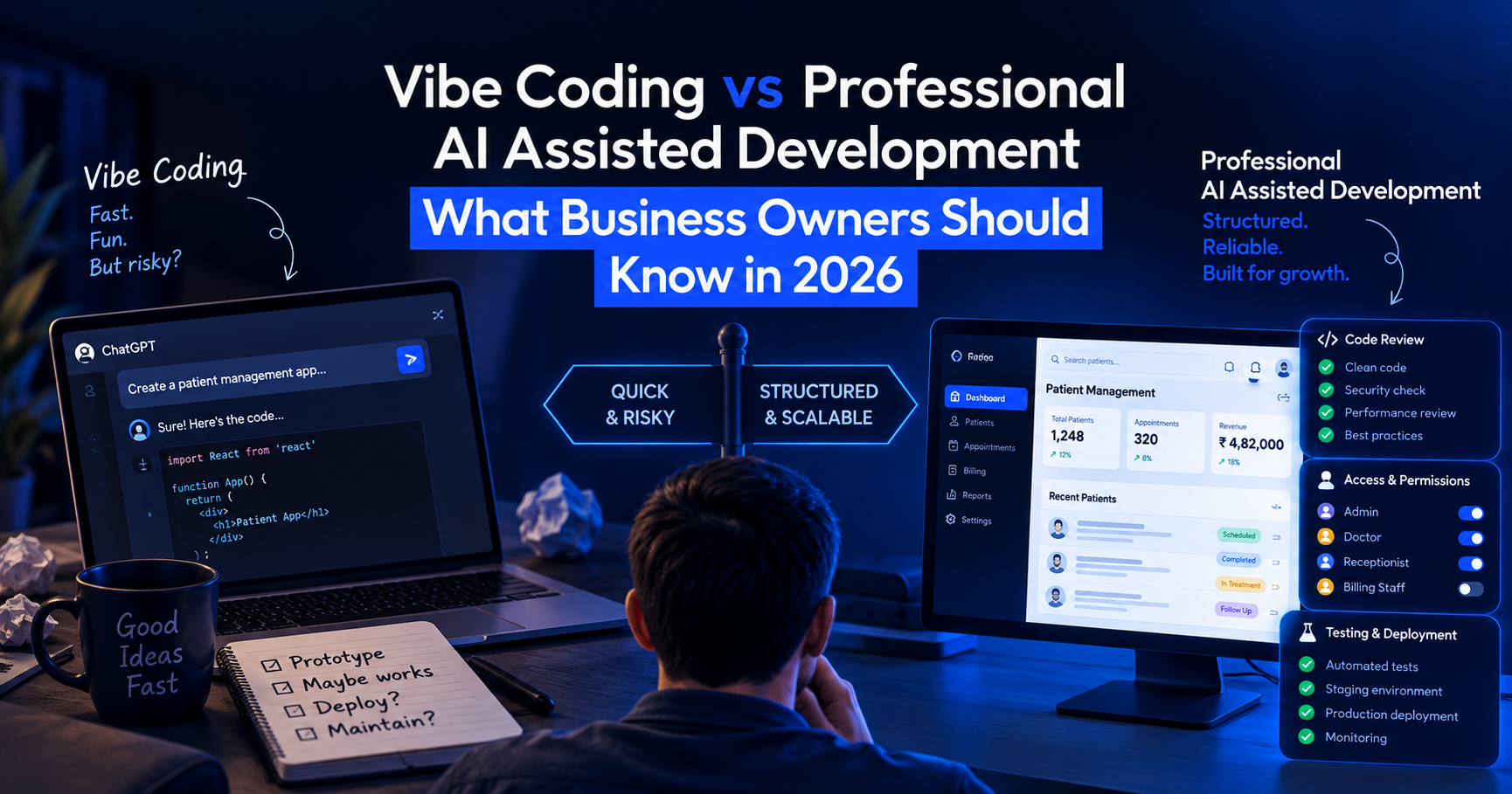
Vibe coding can be useful for prototypes, internal experiments, and low-risk tools. It becomes risky when a working demo is treated as production-ready business software. Professional AI-assisted software development uses the same speed advantage, but places AI-generated code inside a managed engineering process that includes requirements, architecture, testing, security review, documentation, deployment controls, and long-term ownership.
The issue is not whether AI writes code. The issue is whether qualified people can explain the system, verify its behaviour, change it safely, and support it when the business depends on it. AI amplifies the process around it. Strong engineering practices help teams move faster without losing control; weak practices can produce more code than the organization can confidently maintain.
What vibe coding means in 2026
Vibe coding generally describes building software by giving natural-language instructions to an AI tool, running the result, and continuing through prompts until the product appears to work. The term covers a broad range of behaviour. A technically experienced developer may use this style to explore an idea quickly, while a non-technical founder may use it to create an entire application without understanding the underlying code.
The method is attractive because it lowers the cost of experimentation. A business owner can test a workflow, demonstrate an idea to stakeholders, or validate whether users care about a feature before funding a full build. Those are legitimate uses. Risk rises when the prototype begins handling customer data, payments, permissions, compliance duties, or operational processes without a deliberate transition to professional software engineering.
What professional AI assisted development means
Professional software development with AI treats an AI assistant as part of the delivery toolchain. Engineers may use it to draft code, explain unfamiliar modules, generate tests, investigate defects, document APIs, or accelerate repetitive work. Humans still own the technical decisions and the consequences.
A professional team defines acceptance criteria before generating code, works within an agreed architecture, reviews changes, tests failure cases, scans dependencies, controls access, monitors production, and records the information another developer will need later. AI can accelerate many of these activities, but it does not remove them.
Beginner led vibe coding and professional delivery compared
Primary goal
Beginner led vibe coding Get a visible result quickly
Professional AI assisted development Deliver a system that can be operated and changed safely
Requirements
Beginner led vibe coding Prompts evolve while building
Professional AI assisted development User needs, rules, edge cases, and acceptance criteria are documented
Architecture
Beginner led vibe coding Often emerges from generated code
Professional AI assisted development Chosen deliberately for scale, security, integrations, and change
AI generated code
Beginner led vibe coding Accepted when the feature appears to work
Professional AI assisted development Reviewed, tested, and changed to meet project standards
Testing
Beginner led vibe coding Mainly manual happy-path checks
Professional AI assisted development Automated tests plus integration, failure, security, and regression checks
Security
Beginner led vibe coding Depends on prompts and tool defaults
Professional AI assisted development Threats, permissions, secrets, dependencies, logging, and data handling are reviewed
Documentation
Beginner led vibe coding Often limited to prompts or generated comments
Professional AI assisted development Architecture, setup, decisions, APIs, operations, and handover are recorded
Deployment
Beginner led vibe coding Direct or lightly controlled
Professional AI assisted development Repeatable environments, approvals, rollback, monitoring, and incident response
Maintenance owner
Beginner led vibe coding May be unclear after launch
Professional AI assisted development A named team owns updates, defects, security, and support
Best fit
Beginner led vibe coding Prototype or low-risk experiment
Professional AI assisted development Customer-facing and business-critical software
A practical example building the same customer approval feature
Consider a company that wants customers to approve quotations through a secure link. The feature must show the correct quotation, record who approved it, prevent expired links from being used, notify the sales team, and retain an audit trail.
How a vibe coded version may be built
A founder asks an AI builder to add an Approve button, email a link, and update the quotation status. The first version works in a short demonstration. The next prompts adjust the layout, add an email, and fix an error that appears when the link is opened twice.
Several important decisions may remain implicit. Is the link tied to one customer? Can it be guessed or forwarded? What happens when a quotation changes after the link is sent? Are approvals timestamped in a reliable time zone? Can staff reverse an approval? Where are email failures recorded? The visible workflow may work while these operating rules remain undefined.
How a professional AI assisted team may build it
The team first defines the approval states, authorization rules, expiry policy, audit requirements, notification behaviour, and error cases. An engineer decides where approval data belongs, how tokens are generated and stored, and how the feature fits the existing quotation service. AI may then draft the endpoint, database migration, user interface, tests, and documentation.
The engineer reviews every change, checks that secrets and personal data are handled correctly, adds automated tests for reuse and expiry, verifies concurrent requests, and deploys through a controlled pipeline. Monitoring confirms that emails are sent and records unusual failure rates. The finished feature may contain substantial AI-generated code, but the system remains understandable and owned.
How maintenance differs six months later
Suppose the business later needs two approvers for quotations above a defined value. In the vibe-coded system, the developer may discover that the status is stored in several places and the email logic is tightly coupled to the page. A small request becomes a risky rewrite because the original design did not anticipate state changes or preserve clear boundaries.
In the professionally developed system, the team can extend the documented approval model, add a second approval step, update permissions, and run the existing test suite. The change still requires engineering work. The advantage is that the team can estimate and verify the work with less uncertainty.
Why technical debt matters to a business owner
Technical debt is the future cost created when a software decision makes later work harder. Some debt is intentional and sensible. A team may choose a simple implementation to validate demand, record the limitation, and schedule a redesign if the idea succeeds. Unmanaged debt is different: nobody knows where the shortcuts are, why they were taken, or what will break when the software changes.
AI can increase the volume of code produced before the team has increased its review, testing, and maintenance capacity. Google Cloud’s 2025 DORA research, based on survey responses from nearly 5,000 technology professionals and more than 100 hours of qualitative data, found that AI adoption was associated with better throughput and product performance but continued to have a negative relationship with software delivery stability. DORA’s interpretation was that AI accelerates change and exposes weaknesses in testing, version control, architecture, and feedback systems.
A 2025 randomized controlled trial by METR studied 16 experienced open-source developers completing 246 tasks in mature codebases they knew well. With early-2025 AI tools available, participants took 19 percent longer, although they believed the tools had made them faster. The researchers stressed that the result applied to this specific setting rather than every developer or project. The study shows why perceived speed should not replace measured delivery outcomes.
A 2026 preprint analysed 304,362 commits explicitly attributed to five AI coding assistants across 6,275 public repositories. Static analysis identified 484,606 issues introduced by those commits; 89.1 percent were code smells, and 24.2 percent of tracked issues were still present in the latest repository revision. The study used explicit AI attribution and static-analysis rules, so it does not capture all AI-assisted code or every kind of defect. It nevertheless provides useful evidence that some AI-introduced issues can persist rather than disappear during routine maintenance.
These findings do not establish that AI-generated code is inherently poor. They show that speed, quality, and maintainability are separate outcomes. A team can improve one without automatically improving the others.
Common AI coding risks for business software
Code that works only for the demonstrated path
Generated code often satisfies the examples included in a prompt. Production systems must also handle incomplete data, retries, duplicated requests, failed integrations, unusual permissions, large workloads, and recovery after partial failure. These conditions need explicit design and testing.
Security and privacy gaps
An AI tool cannot decide the organization’s risk tolerance or legal obligations. It may not know which information is sensitive, which users should see it, how long it may be retained, or which systems are trusted. Secure development therefore requires defined requirements, protected development environments, review, testing, vulnerability response, and provenance controls. The NIST Secure Software Development Framework organizes these responsibilities across the software life cycle.
Dependencies that become future liabilities
Generated solutions may introduce packages that are unnecessary, poorly maintained, incompatible with the project, or restricted by licensing terms. A professional team checks dependency health and licensing, locks versions, scans known vulnerabilities, and plans updates.
Architecture that becomes difficult to change
Repeated prompts can produce duplicated logic, inconsistent data models, and tight coupling between unrelated parts of the product. Each feature may work on its own while the whole system becomes expensive to modify. Architecture review and code standards reduce this risk.
Loss of knowledge and ownership
Prompt history is not a maintenance plan. If nobody can explain why the system behaves as it does, the business depends on repeated AI interpretation of code that it does not understand. Documentation, clear decisions, and accountable maintainers preserve operational knowledge.
When vibe coding is a reasonable choice
Vibe coding can be appropriate when the software is temporary, contains no sensitive information, has a small and controlled user group, creates little harm if it fails, and can be discarded without disrupting the business. Typical examples include a clickable prototype, an internal proof of concept using sample data, or a one-off automation with a manual fallback.
The business should set a boundary before the experiment begins. If the prototype gains real users, connects to core systems, processes personal or financial information, or becomes part of daily operations, it needs a professional review and a production plan.
What business owners should ask before approving an AI built system
· Who owns the code, architecture, deployment process, and ongoing support?
· Can another qualified developer understand the system without relying on the original prompts?
· Which automated tests prove that the core workflows and failure cases still work?
· How are authentication, permissions, customer data, secrets, logging, and backups handled?
· Which external services and software packages does the system depend on?
· How will vulnerabilities, dependency updates, incidents, and user support be managed?
· Can the team roll back a failed release and restore data safely?
· What documentation will the business receive at handover?
· Which parts are prototypes, which are production-ready, and who approved that decision?
A practical standard for maintainable AI assisted software
A maintainable system does not require every line to be written manually. It requires reliable controls around how code is selected, integrated, verified, and operated. The following standard is a useful starting point for business software:
· Document the user problem, business rules, risks, and acceptance criteria before implementation.
· Choose an architecture that fits expected scale, integrations, data sensitivity, and change.
· Treat AI output as an untrusted draft until a qualified person reviews and verifies it.
· Automate tests for critical workflows and known failure cases.
· Use version control, peer review, repeatable deployment, monitoring, backups, and rollback procedures.
· Maintain an inventory of dependencies, licenses, credentials, and external services.
· Keep setup, architecture, operating, and handover documentation current.
· Assign ownership for maintenance, security updates, incidents, and future changes.
These controls may seem slower than prompting a demo into existence. For software the business will rely on, they reduce uncertainty after launch and make future changes easier to estimate.
AI is strongest when engineering discipline is already present
The most durable position is neither to reject AI nor to assume that generation replaces engineering. AI is useful because it can reduce repetitive work, help teams explore alternatives, and shorten the path from a clear specification to a reviewed implementation. Its value increases when the team supplies good context and uses fast feedback to catch errors.
For a business owner, the right question is not simply whether a supplier uses AI. Ask how the supplier governs its use. A credible answer should cover human review, testing, security, architecture, documentation, deployment, monitoring, and maintenance.
Choosing the right delivery model
Use rapid AI-led prototyping to learn cheaply. Use professional AI-assisted development when customers, revenue, data, compliance, or operations depend on the result. If an existing prototype is beginning to matter to the business, the next step is an engineering assessment that identifies security gaps, technical debt, missing tests, undocumented dependencies, and the work required for reliable operation.
Clousor helps businesses turn promising software ideas and AI-built prototypes into maintainable systems. The focus is practical: understand the business workflow, preserve useful work, address the risks that matter, and create a clear path for support and future development.