In the modern digital landscape, ranking a healthcare website is no longer just about keyword volume - it is about survival.
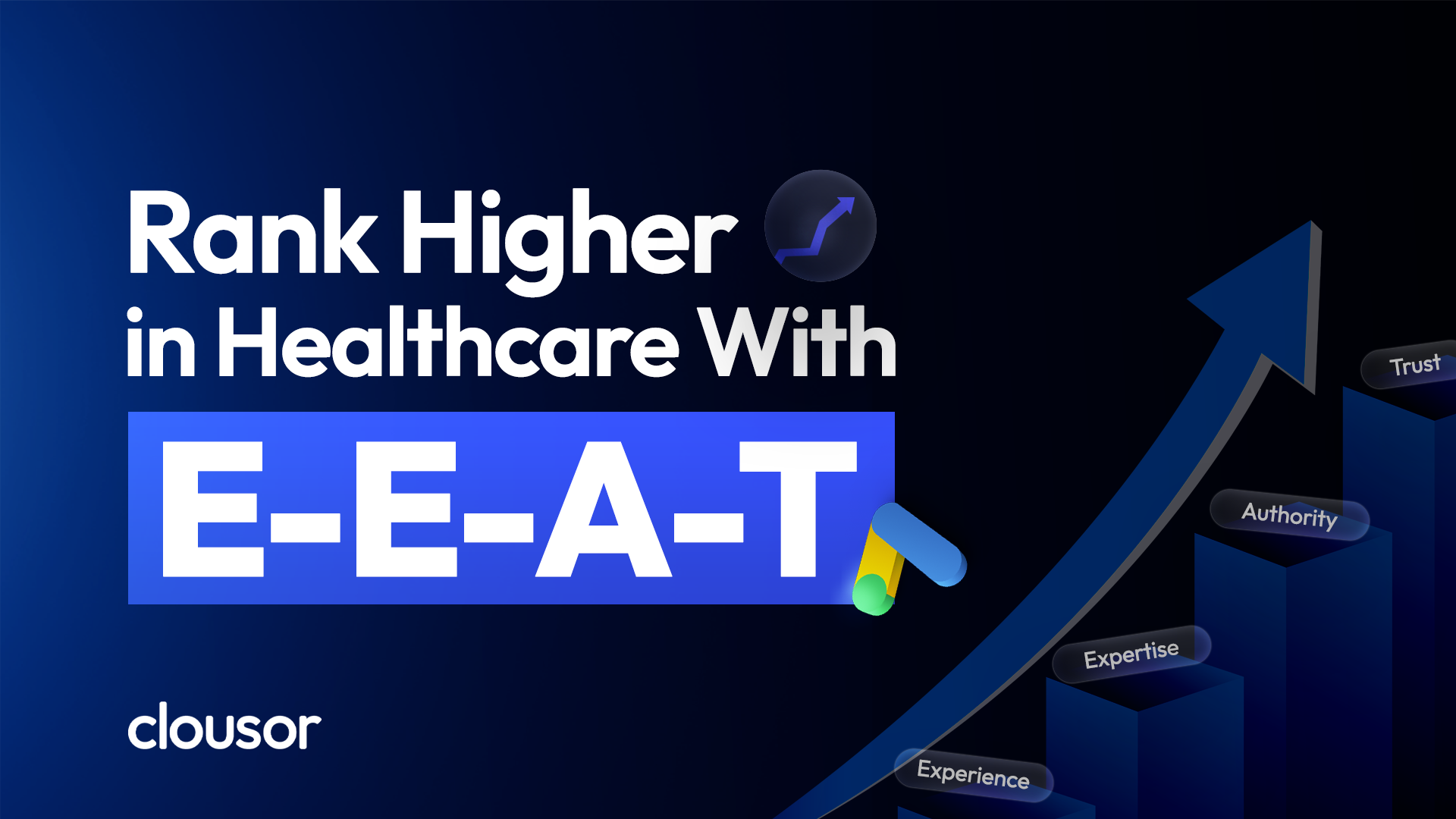
Google classifies healthcare topics as "Your Money or Your Life" (YMYL), meaning misinformation here could significantly impact a person's health, safety, or financial stability. Because the stakes are so high, Google demands the highest standards of quality. The algorithm doesn't just look for relevance; it looks for E-E-A-T: Experience, Expertise, Authoritativeness, and Trustworthiness.
For clinics, hospitals, and private practitioners, this framework is the infrastructure upon which all organic visibility is built. This guide details how to humanize your medical content, satisfy search algorithms and ultimately build the trust that converts searchers into patients.
What is E-E-A-T and Why is it Critical for Healthcare?
E-E-A-T stands for Experience, Expertise, Authoritativeness, and Trustworthiness. While it is not a direct ranking factor with a single "score," it heavily influences how Google's systems evaluate the quality of your content.
- Experience (E): Does the content creator have first-hand knowledge? (e.g., a patient describing recovery or a surgeon explaining a procedure they perform).
- Expertise (E): Is the author a credentialed professional (MD, DO, RN) with verified skills?.
- Authoritativeness (A): Is the website or author recognized as a leader in their field (citations, awards, affiliations)?.
- Trustworthiness (T): The most critical component. Is the information accurate, transparent and safe?.
If your medical content lacks these signals, Google may label it as low quality to protect users from harm.
The 4 Pillars of Medical Credibility: A Playbook
To move from theory to execution, you must systematically inject these signals into every page of your website.
1. Showcase "Experience" to Humanize Content
In late 2022, Google added "Experience" to the framework to differentiate human insights from generic information. This is your opportunity to beat AI-generated content.
- Share Patient Stories: Anonymized case studies (removing PHI) demonstrate real-world success. Describe the patient's journey from symptoms to recovery.
- Provider Insights: Don't just list symptoms. Have your doctors write about their observations. For example, "In our clinic, we often find patients struggle most with evening snacks...".
- Visual Proof: Use original photos of your facility, technology, and staff rather than stock images to prove the business is real and active.
2. Prove "Expertise" with Robust Author Bios
Google prioritizes content created by identifiable individuals with clear credentials. An anonymous admin posting medical advice is a red flag.
- Detailed Bios: Every doctor needs a profile page listing their full name, medical degree (MD, MBBS), board certifications, and years of practice.
- The "Medically Reviewed By" Box: If a professional writer drafts your blog, have a clinician review it. Clearly display a "Medically Reviewed By [Dr. Name]" badge with a link to their credentials and the date of review.
- Link Out: Link author profiles to their LinkedIn, ResearchGate, or hospital directories to verify their digital footprint.
3. Build "Authoritativeness" through Citations
Your website should act like a library of verified information.
- Cite High-Quality Sources: Back up medical claims with links to .gov, .edu, or major organizations like the CDC, WHO, or peer-reviewed journals (PubMed, The Lancet).
- Standardize References: Use a consistent format, such as the AMA Manual of Style, for your reference lists. This signals academic rigor to search engines.
4. Secure "Trustworthiness" with Transparency
Trust is the ultimate arbiter of quality. Even an expert article will fail if the site looks scammy or insecure.
- Editorial Policy: Publish a page explaining how your content is created, reviewed, and updated. This transparency is a massive trust signal.
- Contact & Privacy: Ensure your Name, Address, and Phone (NAP) are visible. Display a clear Privacy Policy and HIPAA/medical disclaimers.
- Security: Ensure your site uses HTTPS (SSL encryption). Google treats non-secure sites as a risk to users.
Technical SEO: Speaking Google’s Language
While humans read your content, search bots read your code. You must use Schema Markup (structured data) to translate your expertise into a language Google understands.
- MedicalOrganization: Defines your hospital or clinic brand.
- Physician: specific markup for individual doctors, linking them to the clinic.
- MedicalCondition: Helps Google understand pages about specific diseases (symptoms, treatments).
- MedicalWebPage: Identifies the page as a medical resource, allowing you to specify the reviewedBy and lastReviewed dates directly in the code.
Pro Tip: Avoid "spammy" markup. Never mark up fake reviews or generic content as patient testimonials, as this violates Google's policies.
Local SEO: Winning the "Near Me" Search
For most clinics, the competition is local. Local SEO overlaps with E-E-A-T by verifying your physical existence and reputation.
- Google Business Profile (GBP): Verify your listing and ensure your category (e.g., "Medical Clinic") is precise. Keep your hours and services updated.
- Review Management: 88% of people trust online reviews as much as personal recommendations.
◦ Respond to everything: Acknowledge positive reviewers and address negatives calmly by legally safe reply.
◦ HIPAA Warning: Never reveal patient details in a reply. Say "Please contact us directly to discuss this" rather than "When you came in for your flu shot...".
- NAP Consistency: Your Name, Address, and Phone number must be identical across your website, Google, Yelp, and Healthgrades.
Measuring Success: Beyond Vanity Metrics
Don't just track traffic; track Trust.
- Content Freshness: Track the median days since your medical content was last updated or reviewed.
- Author Visibility: Monitor how many of your pages have verified author bylines.
- Engagement: Look at "Time on Page" for deep guides. If patients are reading for 3+ minutes, you are likely satisfying their search intent.
Conclusion
The era of "tricking the algorithm" is over. In healthcare, Google’s goal aligns with the patient’s goal: finding accurate, safe, and helpful information.
By adopting a "Trust First" strategy - highlighting real clinical experience, proving expertise with credentials, and maintaining rigorous transparency - healthcare providers can build a digital moat that competitors cannot cross. SEO is no longer just about being found; it is about being trusted.
Disclaimer & Compliance Notice
1. Educational Purpose Only: This guide outlines digital marketing strategies and does not constitute legal or medical advice. Healthcare regulations are strict and vary by region; specific tactics like patient testimonials or "before-and-after" photos may be restricted under NMC (India) or HIPAA (US) guidelines. Always consult your legal or compliance team before implementation.
2. No Ranking Guarantees: SEO is governed by fluctuating third-party algorithms (Google Core & Helpful Content updates). While this guide utilizes current E-E-A-T best practices, specific rankings or traffic volumes cannot be guaranteed.
3. Ethical Standards: We strongly advise adhering to medical advertising codes. This includes ensuring all content is medically reviewed and strictly avoiding "guaranteed cure" claims or prohibited superlatives (e.g., "Best Doctor," "Top Clinic")
 to secure citations in Google AI Overviews..png)